

The case for workflow intelligence
The hidden system failure behind the AI Productivity Paradox.


You know the standup.
Everyone says “done.” Nothing moves. The auth refactor is blocked on something from two sprints ago. That AI-generated module someone shipped last week? It duplicates a feature you built last month. The PR that’s been “waiting on review” sits there for the third day running.
You’re shipping faster than ever. Delivery has never been slower.
I’ve seen this pattern pop up in conversations with other product teams lately. Doug—our Chief Product Officer—even called it out in a recent Inside Atono episode:
“We’ve seen backlogs just grow and grow with no bounds. You’re done with one story and six more show up. It’s a Sisyphean task.”
Welcome to the AI Productivity Paradox.
Many AI tools promise massive productivity gains. Most teams don’t see them. The root cause: individual AI use boosts personal output while disrupting team velocity. Developers complete 21% more tasks and merge 98% more pull requests, but PR review time increases 91%.
Individual velocity ≠ team velocity.
If you’re a Head of Product, you already know this: you spend more time reconstructing context than making decisions. That needs to change.
The bottleneck isn’t execution anymore. It’s coordination. And no system understands your product well enough to keep work aligned at AI speed.
Why legacy tools can’t coordinate modern teams
One insight keeps surfacing: teams can build faster than they can decide what to build.
That’s the insight behind Story Refinement—keeping ideas separate from execution-ready work. Product managers capture ideas and prepare stories in a dedicated space before they hit active development. Ideas move through stages (Idea, Refinement, Ready for Assignment) only when they’re fully specified. This keeps partially-formed concepts from drowning teams in work that isn’t ready to execute.
Legacy tools weren’t designed for this kind of coordination. Jira tracks tasks. Linear manages issues. But if the system doesn’t understand your product, it can’t coordinate your product.
They don’t know what features already exist, how they connect, which architectural decisions constrain new work, or why past tradeoffs were made. Every story is an isolated ticket rather than part of a living system.
The results are predictable. In one enterprise trial, AI-assisted teams generated 18% more commits in a quarter yet shipped zero additional features because review, integration, and coordination couldn’t keep pace.
And that’s the real problem.
Without product-level context, AI generates code that looks right but moves in the wrong direction—duplicating features, violating established patterns, ignoring decisions your team made three months ago.
What Workflow Intelligence actually means
Workflow Intelligence is the missing layer that gives both teams and AI a shared, continuously updated understanding of your product and workflow.
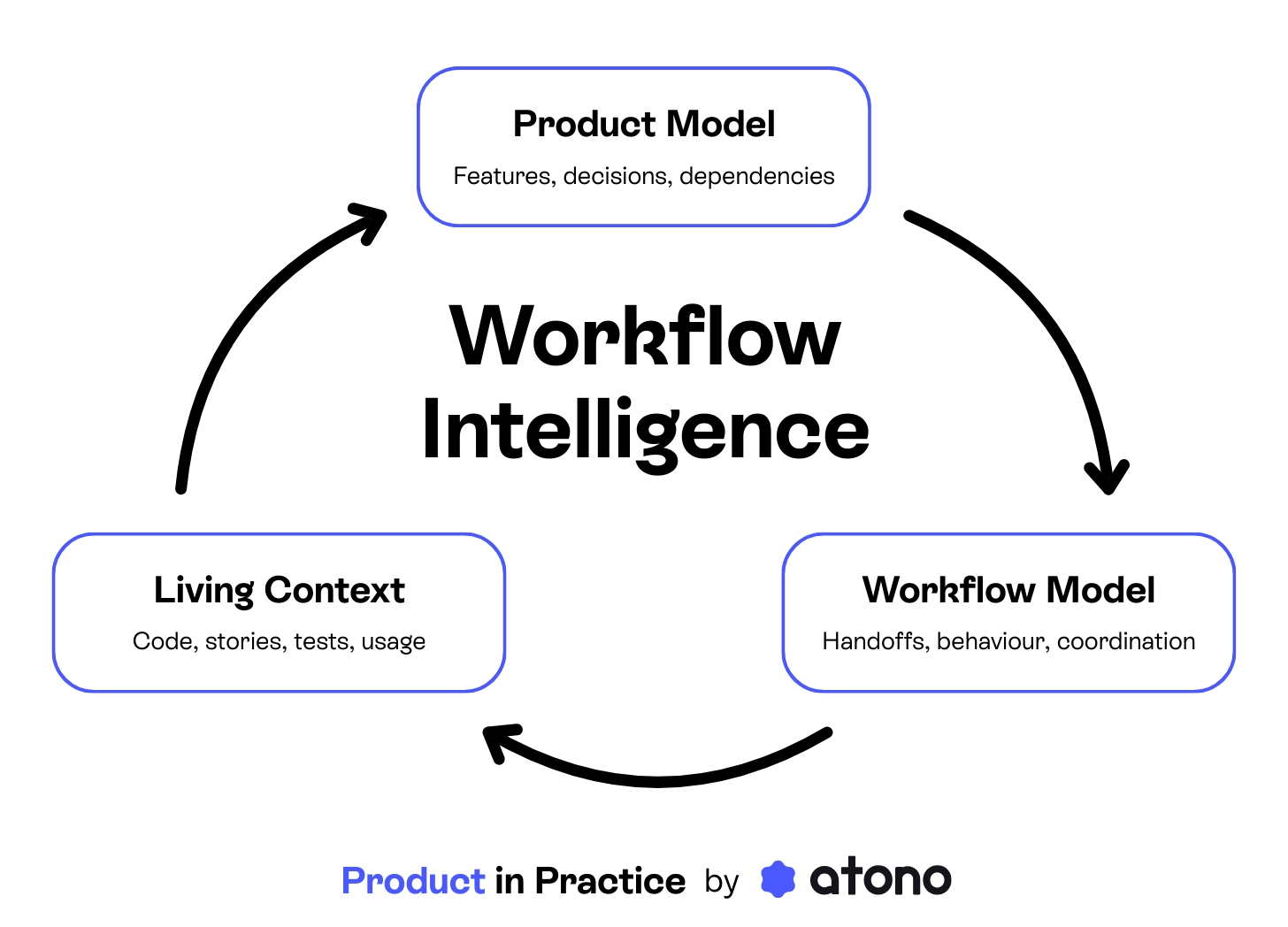
It maintains three interconnected models.
First, there’s the Product Model—a living map that tracks not just what features exist, but why they exist that way. Features, dependencies, decision history, architectural patterns, edge cases, and the reasoning behind tradeoffs. Not static documentation that’s outdated the moment you write it, but real-time understanding that evolves with your product.
Then the Workflow Model learns how work really moves through your organization, identifying where coordination breaks down, which handoffs introduce risk, and where AI-generated changes create downstream chaos. It adapts to team behavior rather than imposing rigid processes nobody follows.
And Living Context ties it all together, synchronizing everything automatically—stories, code, decisions, tests, usage patterns, customer signals. When a developer asks, “Should this be a hard delete or soft delete?” the system provides the reasoning and patterns your team follows, not search results from six different tools.
This is the difference between “a pretty Kanban board” (a visual task tracker) and a learning system—one that continuously adapts based on how your team works, not how you wish they’d work or how you document work in retrospectives nobody reads.
What changes when coordination becomes systematic
Without Workflow Intelligence, here’s a typical Tuesday afternoon:
The PM writes a story based on customer feedback scattered across Slack threads from three different channels. Design creates mocks without any visibility into similar features already in the codebase. A developer picks up the story, gets halfway through, discovers it conflicts with an architectural decision nobody documented, and pings three people trying to reconstruct what happened.
QA tests the feature in perfect isolation, completely missing the integration issues. Two weeks later, analytics show customers can’t find the feature because it doesn’t align with their workflow.
You shipped something. Just not what the customer needed.
With Workflow Intelligence, here’s a better Tuesday afternoon:
Similar features surface automatically the moment the PM starts writing, preventing duplication before it begins. Design sees exactly where the new feature fits within real user flows and existing architectural constraints. Development receives complete context—dependencies, decisions, constraints—without hunting through tools or interrupting people.
QA knows every relevant integration point before testing starts. Analytics confirm alignment with real usage patterns before you deploy.
The difference isn’t saving a few minutes here and there. It’s a system that keeps the entire team aligned without the constant reconstruction work that currently fills 60-70% of a Head of Product’s day.
You know those questions: “Why did we build this?” “Is this work already done somewhere else?” “What decision are we overriding?” Workflow Intelligence eliminates the need to ask them. The system maintains shared context automatically, shifting product leaders from firefighting to forward planning.
Here’s what changes with AI in the mix: this shift becomes critical as teams adopt AI tools, which amplify both the benefits of good coordination and the costs of poor coordination. Get coordination right, and AI accelerates everything. Get it wrong, and AI just creates more mess faster.
Why AI needs Workflow Intelligence to work safely
AI doesn’t fail because it’s incapable. It fails because it’s operating blind.
Generic coding assistants generate plausible code with no understanding of your architecture, established patterns, constraints, or the historical decisions that shaped your product. With Workflow Intelligence, AI stops guessing. It respects architectural boundaries because it understands them. It avoids duplication because it knows what exists. It follows established patterns and surfaces relevant decision history instead of proposing solutions your team already tried and abandoned.
When a developer asks an AI agent, “How should I handle user deletion?” Workflow Intelligence doesn’t just search old tickets—it knows your team soft-deletes for GDPR compliance, references the three stories where this was debated, and points to the existing implementation pattern in the user service.
That’s the context that makes AI useful rather than dangerous.
Industry research is blunt: 74% of companies believe those failing to integrate AI safely across the SDLC risk becoming obsolete. The winners won’t be teams using the flashiest tools. They’ll be teams giving AI the richest context.
AI productivity only materializes when your system can coordinate at AI speed.
Where Workflow Intelligence creates the most leverage
The coordination challenge intensifies on existing systems shaped by years of development.
Most workflow tools assume you’re starting fresh: new codebase, clear requirements, no legacy baggage. But 80% of software teams work on products with years of accumulated complexity, decisions buried in Slack, and constraints that live only in people’s heads.
Traditional tools force teams to reconstruct this context manually for every story. When developers juggle multiple tasks on existing systems, they operate at 40% capacity, with 60% lost to coordination overhead.
But that’s not even the worst part. The worst part is when someone leaves—all that context, all those decisions, all that hard-won understanding—gone. The new person has to rebuild it through detective work: excavating commit messages, hunting through Slack archives, asking “why did we build it this way?” to whoever remembers.
This is where Workflow Intelligence changes everything.
It uncovers and maintains this understanding automatically. Fragile areas nobody wants to touch. Recurring issues that keep coming back. Undocumented dependency chains. Abandoned approaches someone already tried. The decision rationale that explains why things are the way they are.
New engineers understand the system instead of solving mysteries about it. Product leaders work from evidence instead of hunches.
The more complex your product, the greater the leverage Workflow Intelligence creates.
Moving from paradox to advantage
The AI Productivity Paradox isn’t permanent. It’s a signal that workflow infrastructure hasn’t evolved to keep pace with AI-accelerated development.
Research confirms the pattern: 63% of organizations report shipping code faster since adopting AI, yet 72% have suffered production incidents from AI-generated code. The solution isn’t better project management or stricter processes. It’s system-level intelligence that understands your product deeply enough to coordinate work at AI speed.
As Doug often says: “Don’t build the checkbox. Understand the workflow.”
Workflow Intelligence turns coordination from a human bottleneck into a system capability. It maintains context, surfaces relevant information, prevents conflicts, enables AI to work safely, and gives product leaders their leverage back.
The question isn’t whether to adopt AI. It’s whether your workflow infrastructure can support it.
Teams that solve coordination will compound their velocity gains. Teams that don’t will keep experiencing the paradox: working faster, delivering slower, generating more activity, creating less value.
The difference isn’t talent or effort. It’s whether your systems understand your product well enough to turn AI acceleration into real delivery velocity.
Learn how Workflow Intelligence surfaces the hidden context your team needs →